One of the hidden gifts of Agentic AI isn’t just automation. It’s how it forces managers and organizations to rethink work itself, at a level of granularity we rarely reach.
To build an AI agent that can augment or replace human work, you first must define the work precisely—step-by-step, task-by-task.
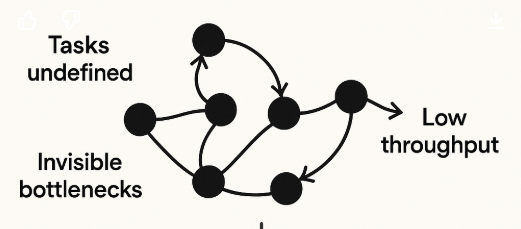
- Tasks must be discrete, describable, and repeatable.
- Complexity must be broken down into atomic units simple enough for a machine.
- Assumptions must be made explicit.
Even if AI can’t fully automate the task, the exercise of mapping it forces powerful improvements:
- Inefficiencies are exposed.
- Optimization opportunities surface naturally.
- Bottlenecks become visible.
Throughput and Bottlenecks:
In any workflow, not all tasks consume time equally.
- Some tasks are critical path—they genuinely determine overall speed.
- Other tasks are hidden bottlenecks—slowdowns that compound delays elsewhere.
By decomposing work into detailed steps (to make it agent-readable), we gain data on task duration and dependency chains:
- Which steps are quick and which are painfully slow?
- Where does handoff between people introduce wait times?
- Which tasks, if accelerated or eliminated, would increase total throughput?
Optimization Questions to Ask:
- What task is taking the longest relative to its value?
- Where do handoffs or approvals slow down the system?
- What bottlenecks could we redesign—or automate—to unblock flow?
- What tasks can happen in parallel instead of sequentially?
Most work is fuzzily defined. Teams operate on habit, not designed flow. AI demands explicitness.
Optimization is a natural side effect. We can’t help but fix inefficiencies once we see them clearly.
Focus returns to value creation. Time and energy shift to the tasks that move the needle.
The real early ROI of Agentic AI may not be automation itself.
It’s in the discipline of clarifying work, spotting throughput constraints, eliminating bottlenecks—and radically improving flow.
Even if your AI agents aren’t ready yet, your teams can be dramatically better off by preparing the ground now.
If you want to prepare for an Agentic future, start by writing down what you do today—task by task, step by step.
Look at how long each task takes and where handoffs stall.
You’ll be amazed at what you can optimize, accelerate, or stop doing entirely.